Category Archives: Protection

Lawns and unsustainable urban buildout are destroying water, bees and us

Two important community issues involving water are the environmental dangers of lawns and the importance of storm drain stewardship.

Storm Drain Stewardship
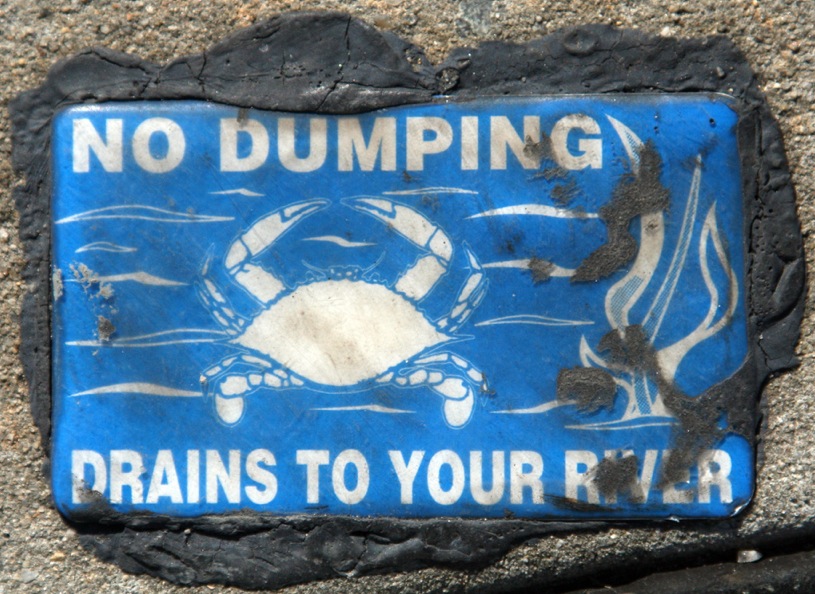
Jersey City drains to your river
Jersey City storm drain marker drains to your river
Because storm drains in most communities carry stormwater out to natural bodies of water, it’s important to keep as much pollution as possible from entering them. Storm drain marker programs have been established in New Jersey and across the country to help make local residents aware of the environmental value of protecting storm drains and the waterways they are linked with.

What flows into storm drains doesn’t come only from roadway surfaces, though. Water runoff from buildings, walk and driveways and lawns washes into storm drains and watershed areas too and from them – right out into our rivers, streams lakes, estuaries and eventually, our oceans. The Milwaukee Riverkeeper defines watershed as, “…simply the area of land that catches rain and snow and drains or seeps into a marsh, stream, river, lake or groundwater.”

Lawn pesticides and fertilizers: A great health hazard
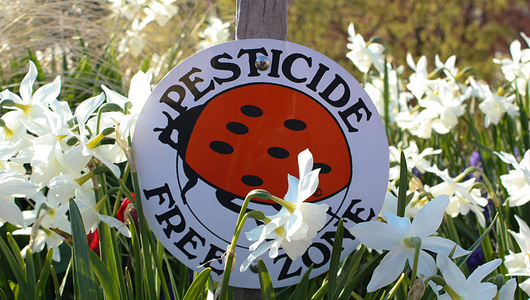
pesticide free zone ladybug signThe enormous quantity of pesticides and over-application of fertilizers on lawns makes them one of the great waterway – and therefor personal – health issues of our time. The Bayshore Regional Watershed Council has a 2007 newspaper article posted on its site cautioning about the health hazards of perfect lawns.

The shimmering green of the finely groomed Long Island lawn may trigger an owner’s pride and neighborhood envy, but it also could pose a serious health risk … Karen Joy Miller, founder of the Huntington Breast Cancer Action Coalition, said pesticides are particularly dangerous for small children who are low to the ground, often barefoot and likely to put things in their mouths. Miller, a breast cancer survivor, said she suspects her sickness was caused in part by exposure to pesticides.

Natural lawn walk
Natural lawn walk
Beyond Pesticides, an environmental education group, tells us about the hazards of pesticides in landscapes and lawns.

Of 30 commonly used lawn pesticides 19 have studies pointing toward carcinogens, 13 are linked with birth defects, 21 with reproductive effects, 15 with neurotoxicity, 26 with liver or kidney damage, 27 are sensitizers and/or irritants, and 11 have the potential to disrupt the endocrine (hormonal) system … A 2004 national survey reveals that 5 million homeowners use only organic lawn practices and products and 35 million people use both toxic and non-toxic materials.

Beyond Pesticides offers a toolkit for organizing your community against pesticides and tips for beginning to eliminate pesticides locally and offers this advice:

A growing body of evidence in scientific literature shows that pesticide exposure can adversely affect a child’s neurological, respiratory, immune, and endocrine system, even at low levels. Young children are particularly susceptible because of their rapid growth and decreased ability to detoxify toxins. Fortunately, there are proven safe, effective, and affordable ways to maintain attractive lawns and playable fields without the use of toxic pesticides.

The EPA also offers pesticide reduction tips. Their tips include recommendations to compost and use native plants.
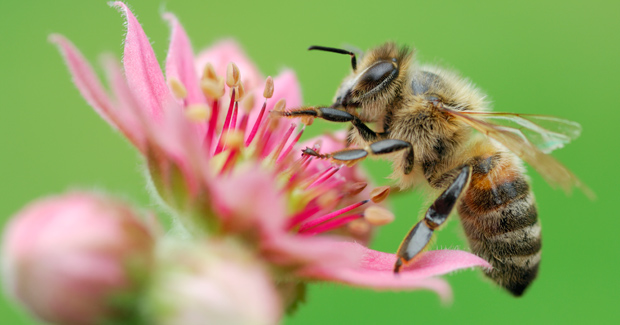
bee pollinating flower

Food supply is being threatened by bee death due to pesticides

Pesticides are dangerous for a number of environmental and health reasons which include the death of bees which society needs to pollinate and grow fruits and vegetables. For the first time this year in California, there were not enough bees on site to pollinate the entire crop of almonds. Weakened immune systems and outright death of bees is being attributed to overuse of pesticides and the reduction of open growth areas in favor of manicured lawns and unsustainably planned cities.

Fertilizers: another big health hazard and their partial ban in New Jersey

Rutgers fertilizer restriction FAQWaterway health depends on the conservation of a delicately balanced ecosystem that must support aquatic plants, fish, seafood and insects as well as the watershed and beach areas surrounding them and the birds and wildlife they support. Over-fertilization of lawns with nitrogen and phosphorous has led to the destruction of waterway health around the country and in New Jersey, some of the nation’s toughest lawn fertilizer laws have been enacted. Rutgers University summarizes the laws in this FAQ. An nj.com article summarizes the reasons behind the laws.

Nitrogen and phosphorus, while important for plant growth, are harmful to the environment if they wind up in the water. Nitrogen is a greater threat to coastal water, while phosphorous is more harmful in fresh water. Nitrogen causes algae blooms that deprive water of oxygen and kill marine life, and in New Jersey, environmentalists and scientists said that nitrogen was the primary reason for the slow death of salt water bodies, especially the Barnegat Bay.

Fertilizers in New Jersey may no longer contain phosphorus, except in special circumstances when a soil test indicates need, or when establishing or re-establishing turf …

Bergen County e-waste collection, tire recycling & doc shredding on 6/22

bcua recycling eventThe Bergen County Utilities Authority (BCUA) will be hosting a computer (e-waste), tire recycling, and personal document shredding event on

Saturday 22 June 2013 9am-2pm
Bergen County Campgaw Mountain Reservation
200 Campgaw Road, Mahwah NJ

The BCUA will be accepting personal confidential documents for on-site shredding from Bergen County residents. The BCUA will also be collecting computer, electronic equipment and old tires for recycling.

Privacy experts often recommend that individuals shred files, tax documents, credit cards and bank statements, and other items which could be used to commit identity theft. Residents will be able to observe their documents being shredded on-site. Acceptable documents are limited to confidential and sensitive materials only. Non-confidential materials, such as books, magazines, newspapers, etc., should be recycled through your local municipal recycling program and will not be accepted at this event. It is not necessary to remove paper clips, staples or paperboard binder covers. In an effort to accommodate all those wishing to participate, there is a limit of 4 bags or boxes of documents weighing no more than 10 lbs. each.

Acceptable electronic equipment includes computers, monitors, printers, circuit boards, speakers, modems, mother boards, power supplies, photocopiers, fax machines, televisions, VCRs and DVD players, stereo equipment, and cellular phones. Residents will be limited to the recycling of four tires per person. Tires will be accepted with or without metal rims.

These recycling services are free and available to Bergen County residents only. Proof of residency is required to participate. No material from businesses will be accepted. For further information about these programs, and for a schedule of future events, residents can call the BCUA Environmental Programs Hotline at 201-807-5825 or visit the BCUA Web site

View flyer

“Fragrance” hides dangerous ingredients – are your beauty products safe?

Screen shot 2013-06-10 at 7.27.58 AMHow messed up in this? Companies can hide the cancer causing ingredients they use in cosmetics and beauty products by calling them “fragrance”. The ingredients in fragrance are protected by Trade Secret laws and can be just about anything. The Environmental Working Group (EWG) cautions us to be careful with “fragrance free” products too: fragrance free doesn’t mean chemical free. Often, “fragrance free” products are created by adding a smell masking chemical to the other chemicals present. This 2:22 minute EWG video gives the scoop:

Are your skin, beauty care and cosmetic products safe? Plug them into the Skin Deep searchable database and find out.

Nestlé in line for Hall of Shame Award over bottled water

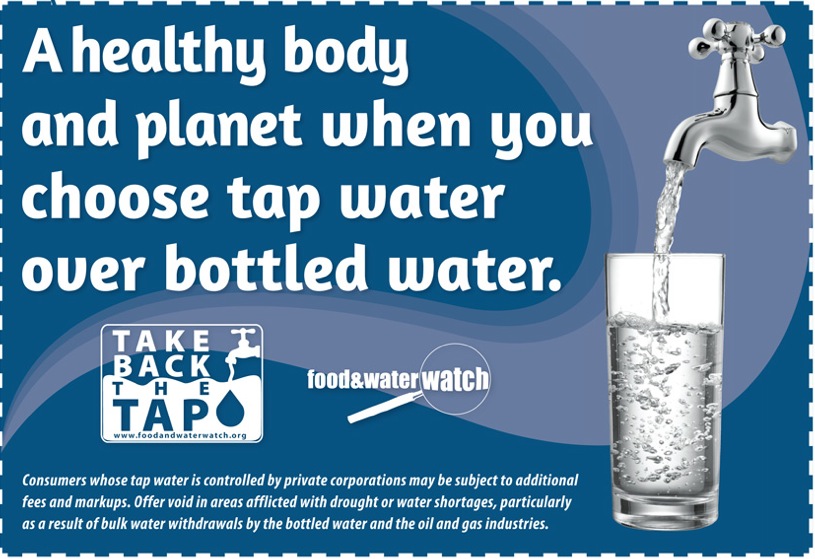
Take back the tapNestlé hoards our world’s fresh water, marks it up 53 Million percent and spends enough on advertising to make you like paying for it. The company is highly effective in helping kill babies by means of watered-down infant formula; sucking up indigenous people’s water supplies in developing countries to bottle and sell in America for astronomical sums; and they’ve got cruel child labor practices in place that Executive VP Jose Lopez says have been company norm, “For as long as we’ve been using cocoa.”

Nestlé shamelessly carries out these acts in order to make $35 Billion profit, putting bottled water in the category of a serious social and environmental justice concern. And according to Daisy Luther of The Organic Prepper, that’s why Nestlé has been nominated for a 2013 Corporate Accountability International Hall of Shame Award. See for yourself: in this YouTube video, Nestle’s CEO remarks on the increasing scarcity of water.

The one opinion, which I think is extreme, is represented by the NGOs [NGOs = Non-Government Organizations], who bang on about declaring water being a public right. That means as a human being you should have a right to water. That’s an extreme solution.

Not bad enough yet? How about throwing a GMO connection into the ring: Nestlé has one of those too. Luther reports:

Monsanto and Nestle are firmly on the same team – Nestle donated over $1 million to the campaign against GMO labeling in California and their CEO has claimed that in 15 years of consumption, no one was every harmed by eating GMOs.

While the world’s attention has been on Monsanto’s corruption of the food supply, Nestle has been quietly draining water sources around the globe and marking it up a mind-blowing 53,908,255%, while the rest of us must deal with droughts, regulations on wells and rainwater, and rising prices.

Just remember, Nestlé’s propaganda statements are so not true. They are just empty marketing words.

The Nestle website touts the slogan: Good Food, Good Life is the promise we commit to, everyday, everywhere – to enhance lives, throughout life, with good food and beverages.

Be a smart world citizen and forget bottled water, like these plumbing shop owners have. The benefits are only a bunch of big fat lies. Drink free tap water instead and help improve our world by doing just a little bit every day to improve our environment and our water quality.

Facebook cofounder illegally destroys Redwood forest

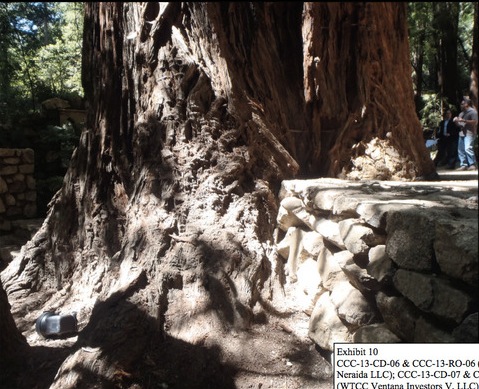
Facebook cofounder intentionally damages Redwood forestFacebook cofounder Sean Parker decided he just had to have a fantasy wedding in the Redwood forest in California, one of the few old growth forest areas left in North America. And fantasy, to Parker and his wife, means f up nature as much as you can. Because nature is nowhere near as cool as what you can buy with $10 million dollars or so and maybe because it’s exciting to break the law. Parker was fined and paid up without complaint: apparently, that was just part of the cost of destroying natural treasures for totally selfish ends. Grist author Holly Richmond comments:

It’s hard to decide what’s most depressing about this. Is it that rich douchebags can buy their way out of anything? That you can fuck up the Earth if you can afford it? That Parker and Co. made no significant effort to limit erosion and redwood damage? That the wedding industrial complex makes people think they’re entitled to barfalicious displays of excess? Thinking about it makes me feel old and tired. I’m gonna go back inside my hobbit-hole. Which, incidentally, I didn’t pay $10 million for.

The Atlantic’s Alex Madrigal quotes the California Coastal Commission Report, which details how much damage was done to the area’s ecosystem.

The Parker Respondents did not install any erosion control measures or any BMPs when they commenced development within the campground. Structures, walls and elevated platforms have been constructed immediately adjacent to Post Creek with no setbacks employed. The Parker Respondents have recently installed temporary fencing in an attempt to reduce potential impacts to Post Creek, but most of the development occurred without any such erosion-control protections in place. Increased erosion resulting from hardscaping and vegetation removal along streams impairs riparian corridors, streams, and, ultimately, shallow marine waters by increased sedimentation. Increased sediment loads in streams and coastal waters can increase turbidity, thereby reducing light transmission necessary for photosynthetic processes, reducing the growth of aquatic plants. Additionally, structures have been built up to and around existing redwoods and vegetation within the campground (Exhibit 10). Beyond immediate physical damage to individual trees, failure to provide adequate development buffers from redwood trees can negatively impact the underground lignotubers by which redwoods clonally reproduce, thus impeding propagation. The unpermitted development has thus impacted the existing redwood forest habitat and has likely caused sedimentation of Post Creek.

You can see before and after photos in both articles and guess what. They’re all disturbing.

Sierra Club did take $25 Million from frackers

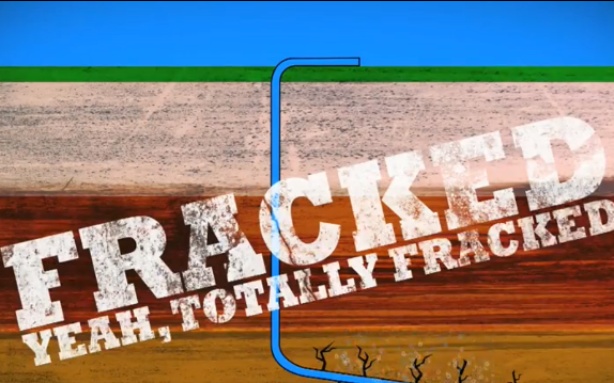
Fracking pipes run diagonally under earthIt’s hard to distinguish the good guys from the bad guys these days, so I do a lot of fact checking. After I heard from a couple friends that the Sierra Club’s silence on fracking had been bought by donations from natural gas companies, I put this item on my research list. Today I had a few free minutes and did some checking

Friends who told me this are radical lefties (which is becoming just another way to say “folk who blame everything on Obama”). In their opinion, Obama is nowhere near progressive enough. Climate change, coal pollution, fracking madness … they blame Obama for all of these environmental ills. I ask, “How can you blame Obama for things that have a history so much longer than his presidency?” They respond that first of all, Obama was a Federal Senator before he was president and had ample opportunity to screw the country back then – and did; and say that as president now, Obama could put a stop to most awful things by invoking Executive Order privilege. Not doing so to help the environment is proof he’s a terrible president and a horrible man.

People in modern days have bought into myths created and disseminated by big monied interests who place profit before any human or environmental interests. I think truths are just beginning to emerge about the state of our world, how much of nature has been destroyed and what we need to do to protect what remains and rebuild our planet’s ecosystem. At this, I think that not many are clear on what are the right ways to go about doing this.

The most correct answer I’ve heard comes from the Indigenous priest group, the Mamas of Medellin, Colombia, who at the Newark Peace Conference in 2011 said we should start treating Mother Earth like she’s really our mother, which she is. One of them asked, what people would go to their mother and tear out great chunks of her flesh? The same way we wouldn’t do that to any flesh and blood mother, we should realize that we cannot do it to our Earth Mother either, as it is she who sustains our individual lives and all life on our world.

But people with less clarity look at things from different perspectives. That’s how the stupid Sierra Club ended up taking money from frackers to fund its campaign to eradicate the coal industry. The Times discovered that

… between 2007 and 2010 the Sierra Club accepted over $25 million in donations from the gas industry, mostly from Aubrey McClendon, CEO of Chesapeake Energy — one of the biggest gas drilling companies in the U.S. and a firm heavily involved in fracking — to help fund the Club’s Beyond Coal campaign … Michael Brune, the Sierra Club’s executive director since 2010, (said) “The first rule of advocacy is that you shouldn’t take money from industries and companies you’re trying to change.”

(Even) Environmentalist Robert F. Kennedy Jr. wrote in 2009 that “the giant advantage of a quick conversion from coal to gas is the quickest route for jump-starting our economy and saving our planet,” and that while gas had environmental caveats, “those impacts are dwarfed by the disastrous holocaust of coal and can be mitigated by careful regulation.”

Now the Sierra Club emphatically does not support fracking and published this statement on their blog

It’s time to stop thinking of natural gas as a “kinder, gentler” energy source. What’s more, we do not have an effective regulatory system in this country to address the risks that gas drilling poses on our health and communities. The scope of the problems from under-regulated drilling, as well as a clearer understanding of the total carbon pollution that results from both drilling and burning gas, have made it plain that, as we phase out coal, we need to leapfrog over gas whenever possible in favor of truly clean energy. Instead of rushing to see how quickly we can extract natural gas, we should be focusing on how to be sure we are using less — and safeguarding our health and environment in the meantime.

The Sierra Club also decided not to take any more money from Clorox, as bleach is not an environmentally safe product either. In 2008 the Sierra Club took $1.3 million from Clorox in exchange for endorsing “the company’s Green Works brand of environmentally-friendly cleaning products.”

Last chance to save orangutans & habitat. Act.

baby orangutanRachel Wieland frames this issue neatly: “We will lose so many species in this generation because we do not realize our small choices make a big impact. For good or bad. If you eat palm oil (especially used in candies and cookies) or use palm oil in your soaps or shampoos, this is destroying the last two remaining orangutan habitats left on the planet. Please take palm oil out of your consumption cycle…” You should know that Rachel is not exaggerating: she’s a Mathematics professor and has been trained to be very precise.

The Indonesian Government has plans to lift protections on vast areas of virgin rainforest on Sumatra island to allow commercial exploitation. Canadian mining company East Asia Minerals is ready to start tearing that rainforest to pieces as soon as Indonesia gives them the go ahead. World citizens cannot allow Eco-habitat and the environment which provides us all with clean air, water and food to be treated as less important than a gold mining operation which will benefit only a select few. Orangutans, palm trees and all of nature are part of that ecosystem and we need to protect those assets. They are yours, mine and they belong to our grandchildren as well.

I join Rachel in asking you to, “Act now! This is URGENT and it must be stopped. Please share this widely and rally up as much support as possible.”

For more information and to offer organizational, financial or other support visit sumatranorangutan.org.

Donate here
Sign petition
Get news updates
Follow on Facebook

Also see http://greenwei.com/blog/nature-v-cookie-money-lessons-for-girl-scouts/

Major corps take over organic brands & dilute them

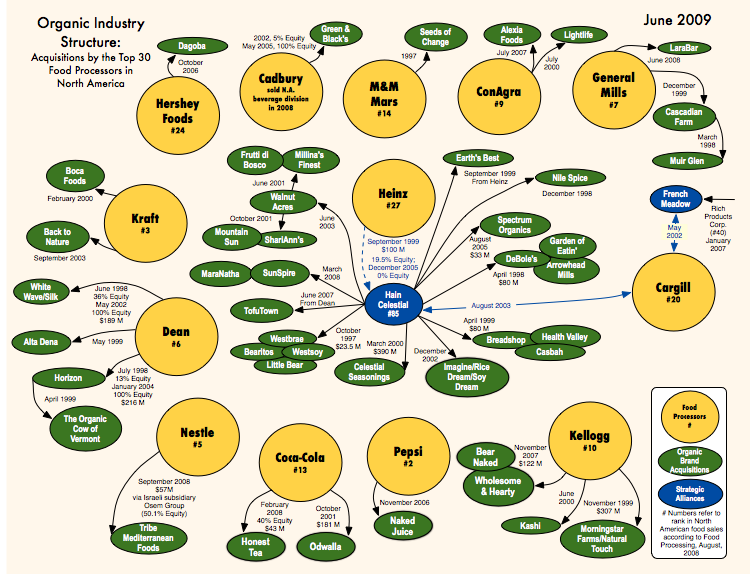
The organic designation in the United States doesn’t have the quality guarantee that it once did. That’s because major corporations have taken over the organic industry and are obviously looking to increase profits. That means buying up independent organic brands and then diluting the “organic” label by throwing their mega-billions of dollars behind lobbying to lower the standards that have protected the organic designation. Lower standards mean more profit, after all.

Is there something else going on here as well? For example, do major corps want to sell us frankenfood because they’re heavily invested in nursing homes, the healthcare and pharmaceutical industries? Well, maybe. That research is still waiting to be done, so stand by, folks.

For today, I can give you this graphic showing all of the once truly “organic” brands that are now owned by major food corporations.

Chart showing organic brands that have been taken over by Big Food companies

I hope all my Jersey friends went out and voted for Board of Education candidates today. Let me know …

Sustainable & green training/events – March

Check back for updates.
Calendar treeNewark-Montclair Urban Teacher Residency – Apply through 3/15
The Newark-Montclair Urban Teacher Residency is an innovative Master of Arts in Teaching (MAT) program offered at Montclair State University in partnership with the Newark Public Schools. Participants will receive free tuition and a $26,000 stipend. A 3-year teaching commitment is required.

Residents enroll in full-time graduate coursework each semester (summer sessions included) and participate in summer internships with community based organizations in the city of Newark. Applications are currently being accepted for Secondary level (K-12) subject matter certification in mathematics or a field of science. Final Application Deadline extended till Friday, March 15, 2013.

More at http://greenwei.com/blog/free-tuition-stipend-for-msu-masters-urban-teacher-residency/

Is Our Water Safe To Drink?
Public Hearing in East Orange sponsored by Councilwoman Alicia Holman
Wednesday, March 6, 2013 6:30 – 8:30pm
CITY HALL, 44 CITY HALL PLAZA, E. ORANGE
https://www.facebook.com/events/557057327645425/

Newark Kids Count 2013 Forum
Wednesday, March 13, 2013 9:30am – 2:30pm
The Paul Robeson Campus Center
350 Dr. Martin Luther King Jr. Boulevard, Newark
https://www.facebook.com/events/386113894821185/#

Using an interactive format, we will explore issues that threaten Newark children and identify concrete next steps that we, as a community, can take. We will focus on two broad areas – child and maternal health and early literacy. Special guests include Newark’s Branch Brook Elementary Principal Joseph Cullen, whose students achieve well above city and state averages on reading tests. The event is free, but you must register to attend. A complimentary breakfast and lunch will be provided.

Register at http://wfc2.wiredforchange.com/o/8716/p/salsa/event/common/public/?event_KEY=71612. For more information contact Reggie Dorsey at rdorsey@acnj.org

NJ Land Conservation Rally
One-day educational conference about preserving
New Jersey’s open space and farmland
Saturday, March 9, 2013 9am – 5pm
NJ Institute of Technology
Newark, New Jersey

Online registration will close at 5 p.m. Tuesday, March 5. Registration fee will remain at $80 per person for a full day of educational & inspiring workshops, breakfast, lunch and social reception. Register online today! Registration will also be accepted at the door.

If you live or work in Newark, Rally scholarships are available, thanks to Victoria Foundation. To become eligible: download, fill out and return registration form.

1st Annual Patricia Harris Parent Summit
Saturday, March 9, 2013 9am – 5pm
John F. Kennedy High School
Paterson NJ

Citywide Parent Summit to continue Pat’s legacy of effective parental involvement and engagement in school improvement.
https://www.facebook.com/events/481929115201697/

Kokokidz Latino Youth Peer Empowerment Group Meeting
Sunday, March 10, 2013 5-6:30pm
Villa de Colombia
12 Mercer Street
Hackensack, NJ
https://www.facebook.com/events/427537817332045/

Young Latinos support each other in the areas of career, education, applying for scholarships, civic engagement, sustainability practices and cultural preservation in their communities. Kokokidz meets once or twice a month in Hackensack or another North Jersey town. If you’re a Latino student junior high school through college age, Kokokidz will help you be more effective in your life and learn to make positive change happen in your school and community.

Contacts:
Ivan Wei 201-688-0036 @ivanwei
Luis Ariel Lopez Wei @lalwei

If you’re available as an adult mentor please contact our advisor Kimi Wei on Facebook or Twitter to discuss volunteer opportunities.

Community Service: We are looking at different types of community service opportunities. If you have a cause or event you’d like us to engage with please share details.

Kokokidz is currently helping with the movement to Close New Jersey schools on Martin Luther King Jr. Day https://www.facebook.com/pages/Close-NJ-Schools-on-MLK-Jr-Day/276810379041778

Climate Action Meeting at Cook College
Sunday, March 10 7pm
Cook Campus Center (Rutgers)
59 Biel Road, Room 202, A & B
New Brunswick, NJ

The meeting will begin with a video chat featuring Bill McKibben of 350.org, followed by a discussion of what actions to do next on the local, state and national levels. Come with ideas and bring friends. The momentum depends on each one of us to act now! For a short capsule of the February 17 Forward on Climate rally event go to https://www.youtube.com/watch?feature=player_embedded&v=anXE46utpo8

Sponsored by Melanie McDermott, Initiative on Climate and Society, Rutgers University and Tina Weishaus, Central Jersey Coalition Against Endless War

Green Drinks 3 (eco chats) March 2013 Schedule

Calendar treeGreen Drinks 3 logo

Green Drinks are about the environment, sustainability, community empowerment, saving the net & happiness
At Green Drinks we are working on building healthy food systems and clean, safe communities. We’re chatting about . . . combatting climate change, composting, biking, kids walking to school, protecting public education, solar energy, alternate fuel cars and better public transit. Each of these is a sustainability topic.

Expert social and environmental justice advocates come out to spend the evening with the community discussing these issues. The point of Green Drinks is to spark conversation about integrating sustainability activities and environmentally friendly practices into our lives and neighborhoods!

WHO’S WELCOME?
You are! We have interesting and lively discussions, and meet at restaurants that serve good, inexpensive food. If you have information to contribute, or just want to learn, you’ll be welcome at Green Drinks. Feel free to bring a friend.

HAPPINESS & SAVING THE INTERNET
Recognizing your blessings is a game changer, so we discuss happiness. Protecting the free and open internet is ESSENTIAL to being happy and empowering communities, so we discuss this too.

CHEERS FROM YOUR HOSTS
Kimi Wei, Ivan Gomez Wei, Angenett Washington & Sally Gellert

MARCH GREEN DRINKS 3 SCHEDULE
Newark 1st Mondays (04 March) 7-9PM
Hackensack 2nd Mondays (11 March) 7-9PM
Paterson-Clifton 3rd Tuesdays (19 March) 12NOON
Visit http://greendrinks3.org/ for other location addresses

Check our list of upcoming events, actions & training